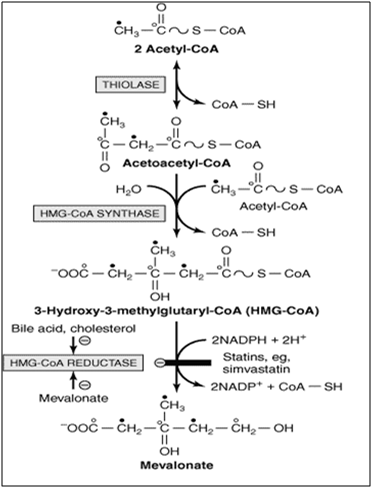
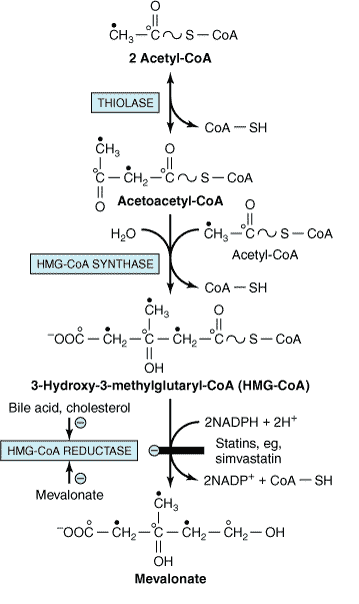
HMG CO A Reductase

Biosynthesis of cholesterol- a quick revision

Biosynthesis of cholesterol The biosynthesis of cholesterol may be divided into five steps: (1) Synthesis of Mevalonate from acetyl-CoA. (2) Formation of Isoprenoid units from Mevalonate by loss of CO2. (3) Condensation of six isoprenoid units forms Squalene. (4) The cyclization of Squalene gives rise to the parent steroid, Lanosterol. (5)Formation of cholesterol from lanosterol. […]

Biosynthesis of cholesterol- a quick revision Read More »
Steps of de novo synthesis of cholesterol

Steps of de novo synthesis of cholesterol Cholesterol is derived from diet, de novo synthesis, and the hydrolysis of cholesteryl esters. A little more than half the cholesterol in the body arises by synthesis (about 700 mg/d), and the average diet provides the remainder. The liver and intestine account for approximately 10% each of the

Steps of de novo synthesis of cholesterol Read More »

Regulatory Mechanisms- Lipid Metabolism (summary Chart)

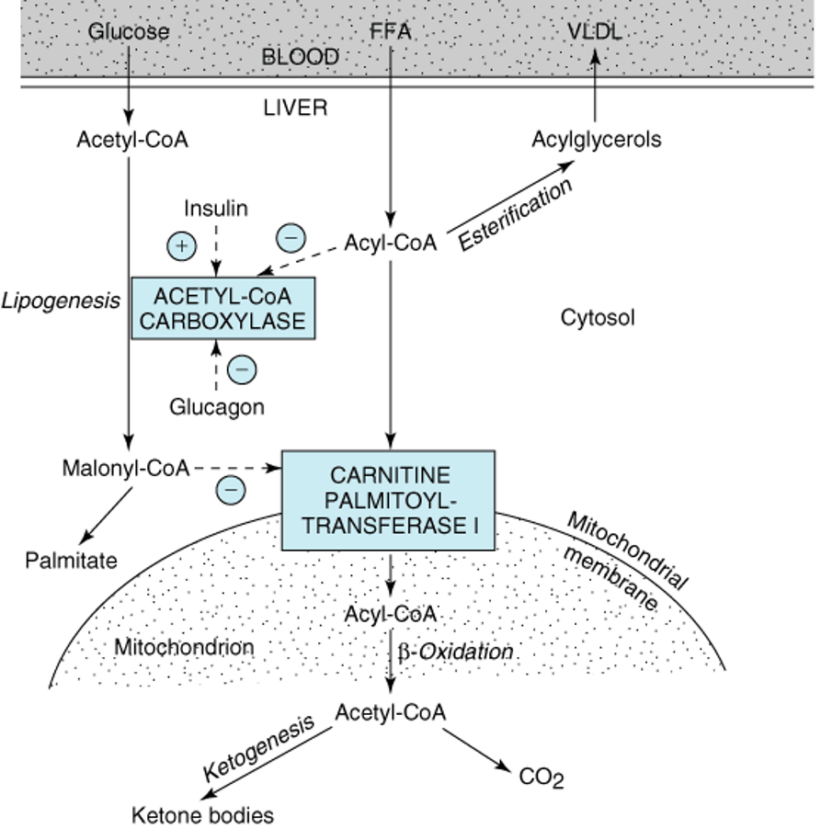
  Enzyme and pathway Effect of substrate concentration Allosteric Modification/ Feedback Inhibition/Covalent modification Induction/ Repression Clinical Significance Acetyl CoA Carboxylase (Fatty acid synthesis) Activity increases during the well-fed state Activity decreases during fasting Activator- Citrate, ATP Acetyl CoA Insulin- activates the enzyme by covalent modification of the enzyme (dephosphorylation through stimulating protein phosphatase enzyme) Inhibitors– Long-chain fatty

Regulatory Mechanisms- Lipid Metabolism (summary Chart) Read More »

Regulatory Mechanisms- Lipid Metabolism (Summary Chart)

Enzyme Pathway Effect of substrate concentration Allosteric Modification/Feedback Inhibition Induction/ Repression Clinical Significance Acetyl CoA  Carboxylase Fatty acid synthesis Activity increases during well-fed state Activity decreases during fasting Activator- Citrate, ATP Acetyl CoA Insulin-by causing de-phosphorylation by stimulating protein phosphatase Inhibitors- Long-chain fatty acids, Epinephrine, Glucagon- via changes in phosphorylation state through c AMP mediated phosphorylation cascade Induced

Regulatory Mechanisms- Lipid Metabolism (Summary Chart) Read More »

×