Glycosaminoglycans and proteoglycans – A quick revision

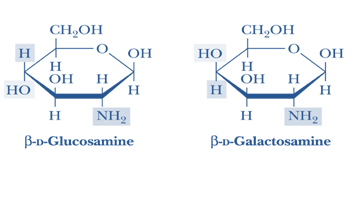
Introduction The most abundant heteropolysaccharides in the body. Highly negatively charged molecules, with extended conformation that imparts high viscosity to the solution. GAGs are located primarily on the surface of cells or in the extracellular matrix (ECM). Along with the high viscosity of GAGs comes low compressibility, which makes these molecules ideal for a lubricating […]

Glycosaminoglycans and proteoglycans – A quick revision Read More »

Multiple-choice questions- Chemistry of carbohydrates- Revision- Set-2

Q.1- Which of the following is not a disaccharide? a) Hyaluronic acid                                             b) Maltose c) Lactose                                            d) Sucrose                                                           Q.2- What is the molecular formula of Glucose? a) CH3OH                                             b) C12H22O11 c) C6H1206                                                             d)  C6H12O5                                            Q.3-Sucrose is composed of which two sugars? a) Glucose and Glucose                                 b) Glucose

Multiple-choice questions- Chemistry of carbohydrates- Revision- Set-2 Read More »

Chemistry of Carbohydrates- Multiple-choice questions- Revision- Set-1

Q.1- Which of the following is a non- reducing disaccharide? a) Galactose                                                                       b) Maltose c) Trehalose                                                                       d) Sucrose                                              Q.2- Which of the following is a true statement about glucose? a) It cannot be utilized by red blood cells b) It has 4 asymmetric carbon atoms c) It is stored as starch in

Chemistry of Carbohydrates- Multiple-choice questions- Revision- Set-1 Read More »

Multiple-Choice Questions- Chemistry of Carbohydrates-set-3

Q.1-Which of the following is a simple sugar or monosaccharide? a) Galactose b) Lactose c) Maltose d) Sucrose Q.2- What is the molecular formula of Glucose? a) CH3OH b) C6H1206 c) C12H22O11 d) C6H12O5 Q.3- Maltose is composed of which two sugars? a) Glucose and Glucose b) Glucose and Galactose c) Glucose and Fructose d)

Multiple-Choice Questions- Chemistry of Carbohydrates-set-3 Read More »

Heparin- Mechanism of action-a case study

Case Details A 54 –year- old woman who was bed-bound in a nursing home began to develop swelling of her left leg. She was evaluated with venous Doppler ultrasound and was found to have a deep vein thrombosis. She was immediately started on heparin to prevent the clot from further enlarging. What is the chemical

Heparin- Mechanism of action-a case study Read More »

Storage Polysaccharides

Glycogen, Starch and Inulin are storage polysaccharides. 1) Glycogen  Glycogen is a readily mobilized storage form of glucose. It is a very large, branched polymer of glucose residues (Figure-1) that can be broken down to yield glucose molecules when energy is needed. Most of the glucose residues in glycogen are linked by α-1,4-glycosidic bonds. Branches at

Storage Polysaccharides Read More »

×